
Creating a certification programme is a strategic way to recognise skills, validate learning and support professional growth. Whether you are an educational organisation, training provider or business, a well-structured certification programme can help build credibility, drive engagement and provide learners with proof of achievement that holds long-term value.
Define the purpose and audience
Before developing any content, identify the main goal of your certification programme. Ask questions like:
- What skill or knowledge does the certification validate?
- Who is the target audience?
- What level of experience is expected?
Having a clear purpose ensures that your programme is focused and aligned with learners’ needs. It also makes it easier to measure outcomes.
Develop relevant and measurable content
To maintain credibility, your certification content should be both practical and structured. Focus on real-world skills that are applicable in everyday contexts. Break the content into modules or units that each address a specific topic. Assessments should test both theoretical understanding and the ability to apply knowledge in practice. Where appropriate, include hands-on tasks or projects that give learners the chance to demonstrate their skills in a meaningful context.
Defining clear success criteria helps ensure your certification retains its value and consistency over time.
Choose the right format and delivery method
Depending on your audience, you might deliver the certification:
- Fully online
- In a blended learning model
- In-person through workshops or training sessions
The format should match the learner’s context and make it easy for them to complete and engage with the material.
Issue verifiable digital credentials
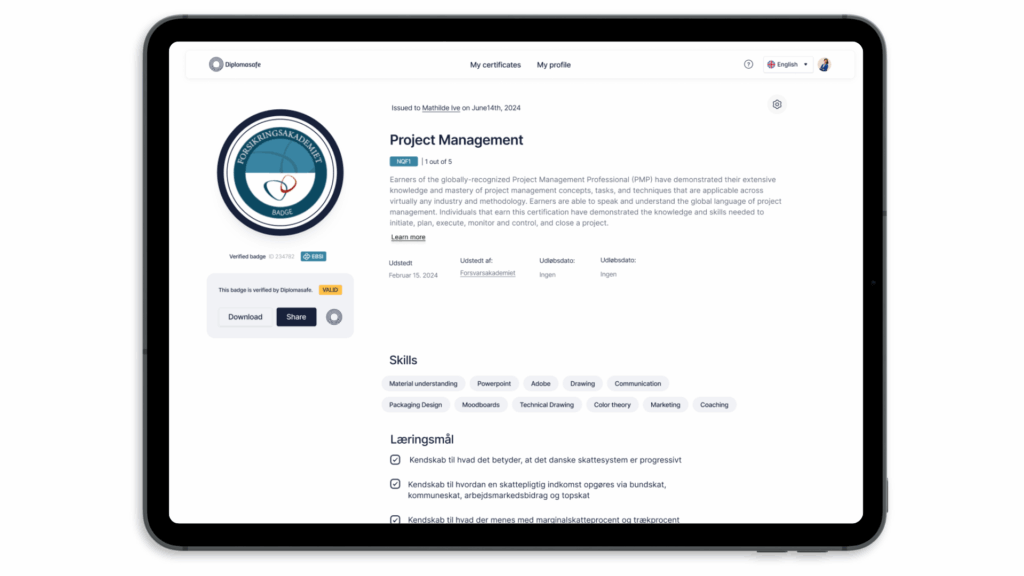
Once learners meet the requirements, issue a digital certificate or badge that reflects their achievement. With a platform like Diplomasafe, you can:
- Customise the credential design to match your brand
- Add skill tags, evidence and metadata
- Distribute certificates directly to digital wallets
- Ensure every credential is secure and easy to verify
Digital credentials enhance visibility, as recipients can share them on LinkedIn, in email signatures or across social media.
Provide ongoing value
A certification programme should not be a one-time experience. Strengthen engagement by:
- Offering advanced or follow-up certifications
- Creating a directory of certified individuals
- Sharing industry updates, training or networking opportunities
This keeps your audience connected and positions your organisation as a trusted source of continued learning.
How Diplomasafe supports certification programmes
Diplomasafe offers an easy-to-use platform for issuing professional, secure digital credentials. You can design certificates or badges that reflect your brand, include detailed metadata and evidence, and track how recipients engage with their credentials. All issued badges and certificates are portable and accessible long-term, supporting lifelong learning.
Whether you are launching a new initiative or improving an existing one, Diplomasafe makes it easy to create certification programmes that are meaningful, measurable and memorable.
Book a demo with Diplomasafe to discover how your certification programme can make a lasting impact.