

What Are Credentials? Types and Examples (For Resumes)
Increase Security, Reduce Costs, and Revolutionise Credential Experience
Adding credentials to your resume will make your application stand out when looking for a job or planning a career change. Credentials connect professionals to credible organisations and provide a verifiable way to ensure employees have the proper knowledge to perform a job.
But what exactly can be considered a credential?
Credentials are any certificate, diploma or licence you may have received throughout your career. They indicate your abilities to perform specific tasks, are proof of your academic achievements or certify your authority when training others, for example. They are issued by an organisation with the competence to attest to your qualifications.
For certain jobs, presenting the correct credentials is more than ideal; they might be indispensable.
This article will explain the most common types of credentials and indicate how and when you should add them to your resume, LinkedIn profile or job application.
Credentials you should include in your resume
Since credentials can cover an array of documents and certificates – including driving licenses, for example – it is essential to assess which information you need to add to your resume and what is unnecessary.
Essentially, there are four types of credentials you should always list on your CV. They will provide recruiters with a better understanding of your academic achievements, training and abilities.
However, before you add every course certificate you ever took or every document you ever received, why not consider your professional goals first? Being aware of how you want to grow is the first step in deciding what you should portray. Your resume is nothing more than an advertisement for yourself, so make sure you know what you want to sell.
From that, you can decide which information you give peers and recruiters the tools to paint a picture of who you are.
Diplomas
Degrees or diplomas are the most common type of credential you’ll find in resumes. In many cases, a university degree is required to take on a particular job. This is undoubtedly the case for physicians, engineers and lawyers, but it is not uncommon for recruiters to indicate what kind of diploma they are looking for.
Including your diploma as one of your credentials in your resume will indicate your interests and background, an excellent introduction to your professional aspirations.
If you have continued your higher education with a post-graduate degree or a PhD, make sure you include them in your CV. This sort of credential is valued in the job market, showing you have the discipline and dedication most companies will be looking for.
Licences
Licences are more specific than a diploma but equally or even more critical. Some careers require professionals to own a license to perform particular tasks, especially if these tasks present risks to you or others.
Licences are the perfect example of a credential that should be part of a resume with a very specific goal. For instance, there is no need to list your driver’s license in your resume if you are not applying for a position as a driver. If you are looking for a career change, you don’t necessarily have to list the licences that helped you perform at your old job.
By the same token, if you are planning to completely transform your professional future, getting the necessary licences to perform that job – even before you get it – is essential. Take the courses and prepare yourself for what you want.
Certificates
Certificates are different from diplomas and degrees. While diplomas are received after a university course, certificates are achieved following a shorter course or training.
You can get certificates for participating in a summit, for studying a different language or for taking a free course on LinkedIn, for example. And they are all valuable. They will reveal your interest and are a great way of demonstrating your constant pursuit of professional development.
Just like with licences, it is recommended that you acquire the proper certificates before changing your career. Having the correct credentials on your resume will help you advance professionally.
Certifications
Certifications are different from certificates and licences. They demonstrate someone’s training and dedication to a more specific subject than a course. People might have certifications attesting to their ability to work with a software or tool, for example, an ability that will not necessarily be transferable to another area of expertise.
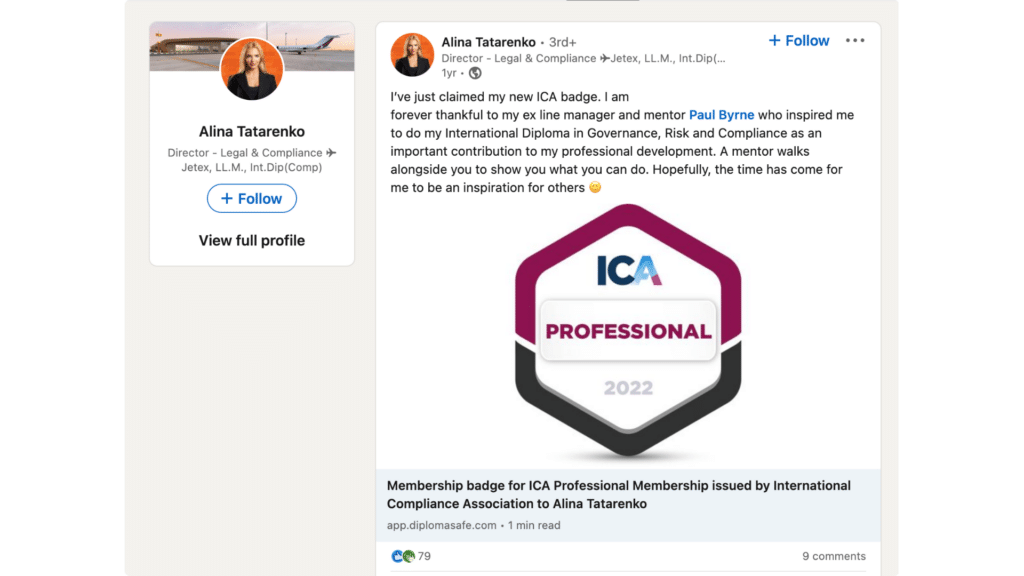
These certifications might appear in your resume or LinkedIn profile as a badge.
What are digital credentials?
Most often used on social media pages like LinkedIn, badges are an example of a digital credential. They can also be a representation of an association with a company or organisation that will attest to your expertise.
One of the benefits of having digital credentials is how easy it is to share them on multiple mediums. Badges and seals can quickly become a conversation starter, sending peers and recruiters straight to the source of your achievement.
If listing your credentials on your resume is extremely important, having them in the digital format displayed on social media pages or professional websites is just as relevant.
Digital credentials also provide recruiters and future employers with a trusted source of information about your certifications. They are easier to verify and create an increased sense of transparency in the hiring process.
In an increasingly digital world, presenting certificates in a digital format can be easier, cheaper, and better for the environment. Companies like Diplomasafe ensure credentials issued by educational businesses and organisations are verifiable and credible, as demonstrated by our dashboard that helps manage and showcase these digital credentials effectively.
Why are resume credentials so important?
As we’ve discussed, adding credentials to your resume improves your chances of getting noticed by recruiters. It is also an essential step towards a career change, especially if you are committed to improvement and seek the proper qualifications.
Resumes are, after all, a long list of credentials. Your CV should reflect what you have done professionally, but also everything you have achieved academically and intellectually. They are an opportunity for you to showcase your expertise. Therefore, you should boast about your credentials.
More importantly, having credentials – and relevant credentials – will help you get the proper attention, improve your chances of making more money, and develop your professional goals.
Digital credentials can be even more beneficial to your career goals, as they will connect you to credible organisations in a way that is easy to verify and confirm.
Conclusion
Credentials are essential pieces of information to add to any resume. They can indicate a variety of goals, interests and purposes, and they are relevant for employees, recruiters and companies.
Adding your credentials to your resume will improve your chances of getting hired and reveal your commitment to your craft. Having digital credentials available on your social media pages will also give recruiters an easy way to verify that you have the knowledge and expertise they are looking for.
It is a must to present credible credentials from institutions that are well-regarded in their area of expertise. In a digital environment, digital credentials are also a source of positive attention for professionals and for the businesses that issue them.
FAQ
What types of credentials exist?
Credentials broadly fall into three categories: competency credentials, authorisation credentials, and organisational credentials.
Competency credentials confirm a person has completed a learning programme or demonstrated a skill. These include academic degrees (with diplomas and transcripts), professional certifications (e.g. CFA, CPA), micro-credentials, vocational qualifications, and continuing education certificates. They can be issued as diplomas, certificates, or digital badges.
Authorisation credentials confirm a person is legally permitted to perform a specific activity or work in a regulated field. These cover areas such as vehicle operation, heavy machinery, hazardous materials, regulated professions (e.g. doctors, lawyers, electricians), food safety, and security. They are typically issued as licences, certificates, or permits by government or regulatory bodies, and must be renewed regularly to remain legally valid.
Organisational credentials are issued to companies or institutions, confirming they meet a defined standard of quality, safety, or compliance. Common examples include ISO certifications, environmental certifications, and sector-specific accreditations. Like personal credentials, they carry expiry dates and must be periodically renewed.
Who issues credentials?
Credentials are issued by any organisation that has the authority to formally recognise and verify a person’s qualifications or achievements. This includes universities and higher education institutions, vocational and professional training providers, industry certification bodies, regulatory authorities, and membership organisations. The credibility of a credential depends directly on the credibility and recognition of the issuing institution.
Where are credentials used?
For the individuals who hold them, credentials are how they demonstrate what they know and what they can do – to employers, to other institutions, and to regulatory bodies. A credential is only as useful as it is trustworthy, which is why the ability to verify a credential quickly and reliably matters as much as the credential itself.
For the institutions that issue them, credentials are a direct expression of quality and credibility. A well-issued, verifiable credential reflects positively on the institution behind it – and a credential that cannot be trusted reflects poorly, regardless of the programme it represents.
Credentials are used wherever qualifications need to be verified – when applying for jobs, further education, professional licences, or membership of regulated bodies. As credentials move from paper and PDF to verifiable digital formats, verification is becoming faster, more reliable, and harder to falsify – benefiting issuers, holders, and verifiers alike.
What are digital credentials?
A digital credential is the digital equivalent of a traditional paper or PDF-based certificate, diploma, licence, or badge. Any credential that can be issued on paper can be issued digitally – from a Bachelor’s degree or a professional certification to an operator licence or an ADR certificate for the transport of dangerous goods.
The fundamental difference is not the format, but the verifiability. A paper credential can be lost, damaged, or falsified. A digital credential is permanently accessible and cryptographically secured – meaning its authenticity can be confirmed instantly by anyone, anywhere, without contacting the issuing institution.
What makes a digital credential different from a PDF?
A PDF is an analogue document in a portable format. Like a paper credential, it can be edited or falsified. A digital credential is not a document in the traditional sense – it is a permanent, tamper-proof record issued and held by the issuing institution. Any analogue version, whether a PDF or a printed copy, is always checked against that original digital record when verified. If the analogue version has been altered in any way, verification fails instantly.
How digital credentials are used
Digital credentials can be shared directly by the holder – via a link, a QR code, or on professional platforms – giving employers, regulators, and other institutions immediate access to a verified, trustworthy record. For authorisation credentials such as licences and operator certificates, digital issuance means that validity and expiry can be checked on the spot, without paperwork or manual checks.
Benefits for issuing institutions
For universities, certification bodies, and regulatory authorities, digital credentials offer significant advantages over paper-based issuance:
Real-time revocation and expiry management – if a credential needs to be revoked, or an authorisation licence expires, the status is updated instantly and reflected in every verification check. No recalls, no physical document retrieval, no outdated paper records circulating in the market.
Verification without friction – third parties can verify credentials instantly without contacting the institution, at any time and from anywhere in the world. No emails, no phone calls, no manual checks.
Reduced administrative burden – verification requests, replacement certificates, and confirmation letters are among the most time-consuming administrative tasks for credential-issuing institutions. Digital credentials eliminate most of them.
Lower cost of issuance – printing, embossing, postage, physical storage, and re-issuance of lost certificates all carry a cost. Digital issuance removes them, delivering significant savings at scale.
Fraud prevention – paper and PDF credentials can be falsified. Digital credentials cannot. Any analogue version is always verified against the original digital record, making fraud immediately detectable.
Wallet compatibility – digital credentials can be stored in digital wallets, allowing holders to carry and present their qualifications alongside other identity documents. As digital wallet infrastructure matures across Europe and globally, credential interoperability becomes increasingly important for institutions that want their qualifications to be recognised and usable across borders and platforms.
Modernisation of institutional processes – digital credential issuance is a natural part of broader administrative digitalisation. Institutions that issue digitally signal to students, partners, and regulators that they operate to modern standards – and they future-proof their credentialing infrastructure as paper-based processes become increasingly inefficient and outdated.
Interoperability and standards compliance – digital credentials can be aligned to open standards such as Open Badges and W3C Verifiable Credentials, ensuring they are recognised and readable across systems, platforms, and national borders.
Scalability – whether issuing ten credentials or ten thousand, digital issuance scales without additional cost or complexity. Graduation seasons, large professional certification programmes, and mass licence renewals can all be handled without the logistical burden of physical production and distribution.
Environmental impact – eliminating paper, printing, and postage reduces the institution’s environmental footprint. For institutions with sustainability commitments, digital credentialing is a tangible and measurable step.
Lifelong accessibility for recipients – holders can access, share, and present their credentials at any time, without risk of loss or damage. This reflects well on the issuing institution and reduces the administrative burden of handling replacement requests years or decades after issuance.
Can a digital credential be changed after it has been issued?
No. The digital credential issued through Diplomasafe is a permanent, unalterable record – the source of truth. Nothing and no one can change it after issuance.
Recipients can download an analogue PDF version of their credential. A PDF is not a digital credential – it is a portable document, and like any analogue document it can be edited. If anyone attempts to alter that PDF – changing a grade, a name, or a date – it will immediately fail verification, because every verification check is made against the original digital record, not the PDF.
For institutions that require a signed PDF, Diplomasafe supports PAdES digital signatures, which apply a digital signature to the analogue PDF at the point of issuance. And where paper is part of the process, both the paper and PDF versions carry a QR code that directs back to the digital record. Scanning that code allows anyone to instantly verify whether the analogue version – paper or PDF – matches the original, and whether it has been tampered with.
The digital credential is always the reference point. Everything else is checked against it.
Is a CV a credential?
No. A CV is a self-reported document – a structured summary of a person’s experience, qualifications, and achievements as described by the person themselves. It is not independently verified and carries no institutional authority. Credentials are the verifiable evidence behind the claims a CV makes.
This distinction matters more than it might seem. An employer reading a CV has no way of knowing whether the qualifications listed are accurate, current, or even real – unless they can be verified. A digital credential closes that gap entirely. Rather than asking a candidate to list their qualifications, institutions and employers can verify them directly, instantly, and without any involvement from the candidate.
For the institutions that issue credentials, this is significant: a verifiable digital credential is not just a document handed to a graduate or certificate holder. It is an independently accessible record of what that person achieved – one that remains trustworthy long after the original paper copy has been lost, altered, or forgotten.
What is credential verification?
Credential verification is the process of confirming that a credential is authentic, was issued by a legitimate institution, and has not been altered or falsified. It answers three fundamental questions: was this credential genuinely issued, by whom, and is it still valid?
Verification matters because credentials are only as trustworthy as the ability to check them. A paper diploma or a PDF can be falsified. A credential that cannot be independently verified places the burden of trust entirely on the document itself – which is no guarantee at all.
Digital credentials change this fundamentally. Because the digital record is permanent and held by the issuing institution, verification is instant and requires no manual intervention. An employer, a regulator, or a border authority can verify a digital credential in seconds – by scanning a QR code or following a link – and receive an immediate, authoritative confirmation of its authenticity and current status.
For issuing institutions, this has a direct implication: every digital credential they issue comes with built-in verification. There are no verification requests to handle manually, no confirmation letters to write, and no risk that a falsified document will go undetected. The institution’s authority is embedded in the credential itself.
The importance of issuing digitally is only growing. Europe is moving rapidly into the wallet era, led by the EU Digital Identity (EUDI) Wallet – a standardised digital wallet being rolled out across all EU member states under Regulation (EU) 2024/1183, which amends the eIDAS framework to establish a European Digital Identity. The EUDI Wallet allows every EU citizen to store and present verified credentials, identity documents, and qualifications directly from their phone. Pilot programmes have specifically tested the use of digital diplomas and recognition of professional qualifications across borders – confirming that educational and professional credentials are a core part of the wallet infrastructure, not an afterthought.
When a credential is issued in a format compatible with the EUDI Wallet – built on open standards such as W3C Verifiable Credentials 2.0 (an official W3C standard since May 2025) and Open Badges 3.0 – it is not just digitally accessible. It is recognised as legitimate across all EU member states and increasingly beyond European borders. For institutions that issue credentials today, digital issuance is not only a practical improvement. It is preparation for an infrastructure that will define how qualifications, licences, and authorisations are stored, shared, and verified for decades to come.